Server decommissioning without proper data erasure leaves sensitive information exposed and recoverable, creating significant security and compliance risks. This KB provides a clear, step-by-step process on how to wipe server systems securely using BitRaser Drive Eraser, ensuring complete and irreversible removal of data across all connected drives.
BitRaser Drive Eraser enables secure data wiping across leading enterprise servers from major vendors, including rack and blade servers, as well as custom-built configurations, such as:
- Dell PowerEdge R750, R760, R760xs
- HPE ProLiant DL380 Gen10 Plus and Gen11
- Lenovo ThinkSystem SR650 V2, V3, and V4
- Supermicro Ultra and Hyper series

Image: Popular Server Models
BitRaser Drive Eraser can be used to securely wipe all standard server disk drives, regardless of whether they are SATA, SCSI, SAS, or Fibre Channel, and is compatible with all common sector sizes (i.e., 512-byte, 520-byte & 4096-byte sectors). Additionally, BitRaser supports automatic dismantling of RAID arrays for various controller types (e.g., MegaCLI, Adaptec RAID & Dell PERC). For RAID dismantling an unsupported controller, refer to our KB for detailed instructions.
Key Requirements:
Ensure the following requirements are met before starting the server wiping process:
- x86 or x64-based system
- Minimum 16 GB RAM recommended
- Internet connection (Ethernet preferred)
- USB drive (minimum 2 GB) to create BitRaser bootable media
- Valid BitRaser Drive Eraser license
How to Wipe Server Systems Securely
Follow the steps below to understand how to wipe server data securely using BitRaser.
Step 1: Log in to your BitRaser Cloud account. From the left panel, open the ‘Download BitRaser’ section and select the latest BitRaser Drive Eraser ISO file.
Step 2: Use Rufus, a bootable media creation tool, to create a bootable BitRaser USB. For detailed instructions, refer to the KB: How to Create a Bootable USB Using Rufus.
Step 3: Insert the bootable USB into the server and restart the system. Access the boot menu using the designated function key and boot the server using the BitRaser USB.
Once the server is booted, the BitRaser interface will appear, displaying all connected drives on the main screen (See Image 1).

Image 1: BitRaser Drive Eraser Main UI
Step 4: Go to Settings > Network and connect the application to the internet using Ethernet or Wi-Fi. Since the server is configured with DHCP, the network is assigned automatically when you select Automatic (DHCP). You can also configure the network manually if required (See Image 2).
Note: You can pre-save Network and BitRaser Server details by customizing the application using the ISO customization feature. This helps save time and lets you skip these steps. To learn how to customize the BitRaser ISO, refer to our KB.

Image 2: Connect BitRaser Application to the Internet
Step 5: Go to Settings > BitRaser Server and enter your BitRaser Cloud credentials to allow the application to fetch erasure licenses from the BitRaser server. This also enables automatic saving of erasure reports and certificates to your secure BitRaser Cloud account (See Image 3a & 3b).

Image 3a: Enter Credentials to Connect with BitRaser Server

Image 3b: Erasure Licenses Fetched & Connection Established
Step 6: Select the ‘Erasure Method’ and ‘Verification’ from the drop-down menu as per your organizational policies. For NIST Purge, the verification type is fixed as Total Verification (See Image 4).

Image 4: Select Erasure Method & Verification Type
Step 6: Once selected, click ‘Erase’. A confirmation pop-up will appear asking you to confirm the erasure. Click ‘Yes’ (See Image 5).

Image 5: Confirm Erasure
The application will prepare the disks and start the erasure process. You can track the progress on the application interface. Erasure licenses are automatically deducted based on the number of drives selected for erasure (See Images 6a, 6b & 6c). Once the process is complete, an erasure report is automatically generated and saved to your cloud account.

Image 6a: Preparing Disks for Erasure

Image 6b: Server Wiping Progress

Image 6c: Server Wiping Completed
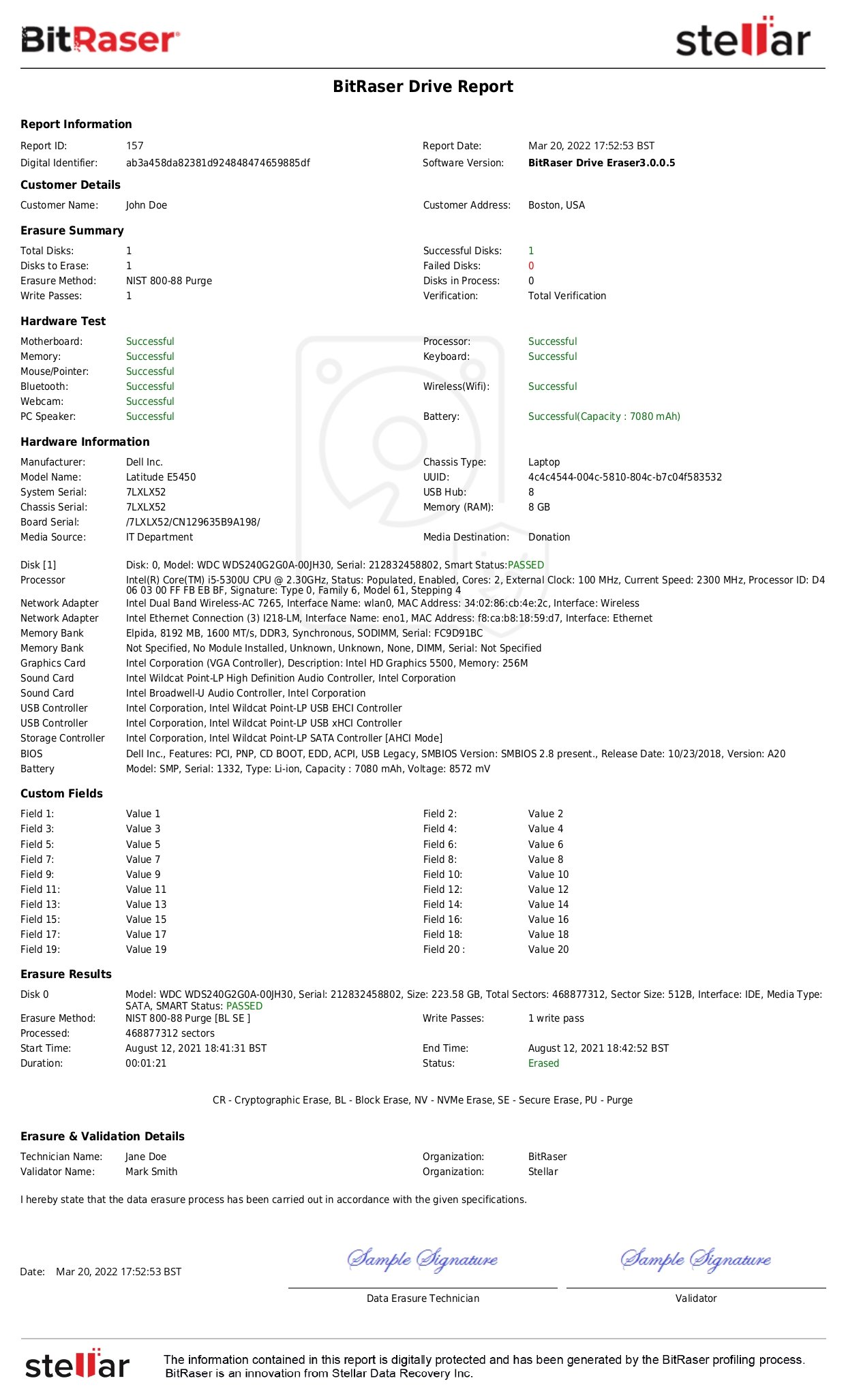
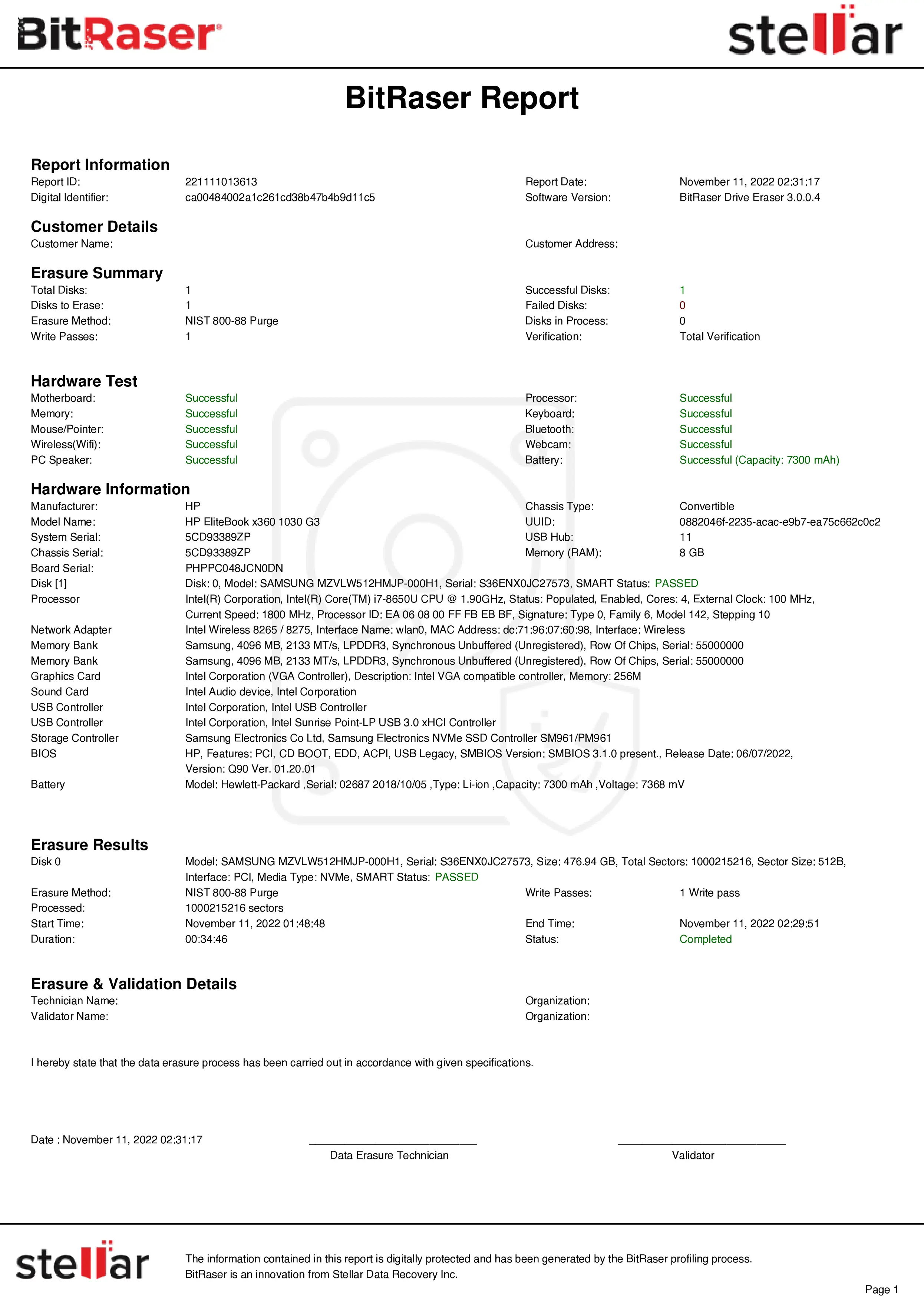
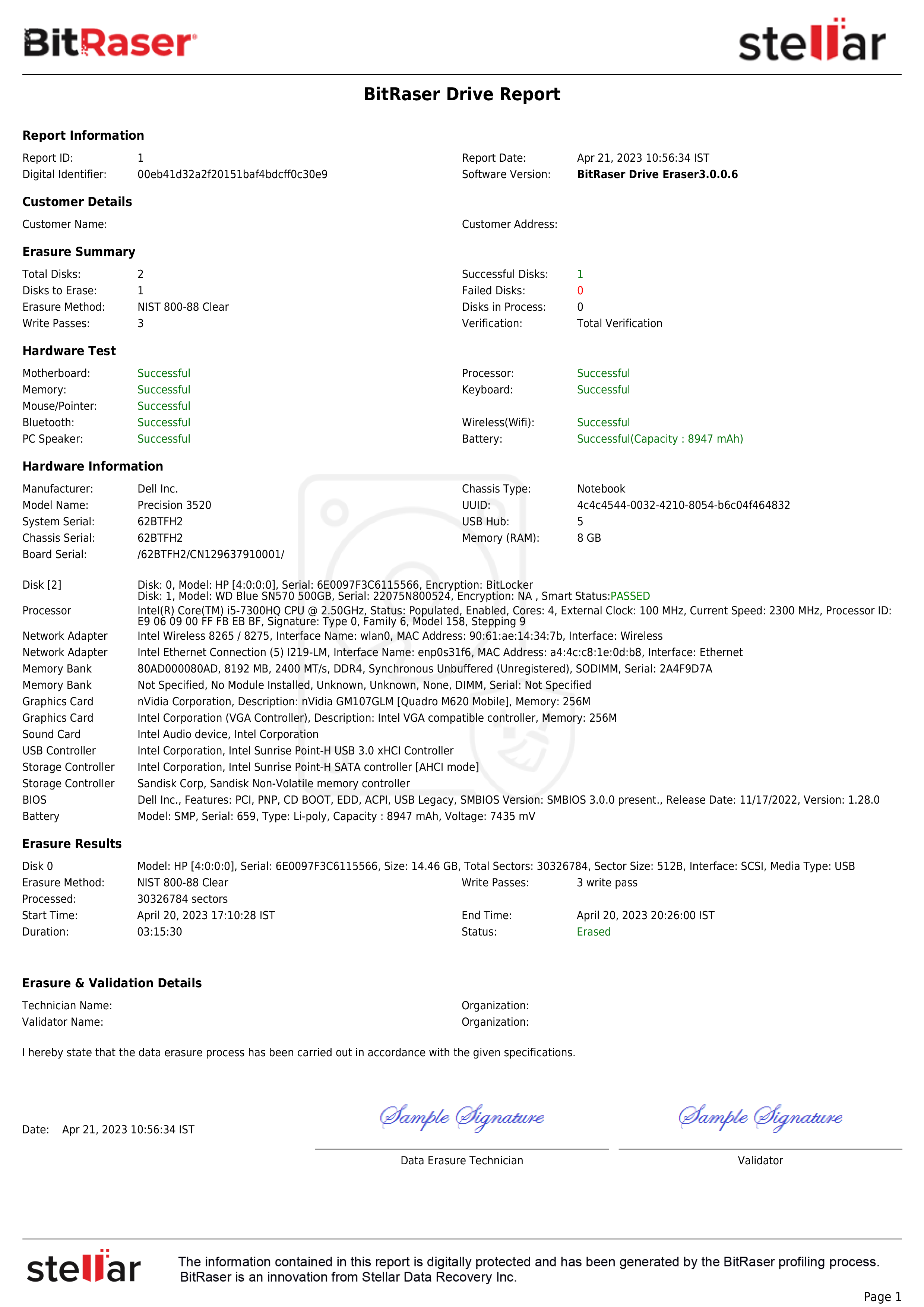
Congratulations, you have securely & successfully erased multiple server drives using BitRaser Drive Eraser software. You can view the erasure report below.

Server Wiping Report BitRaser Drive Eraser
For detailed, server-specific erasure steps, refer to the following KB guides: